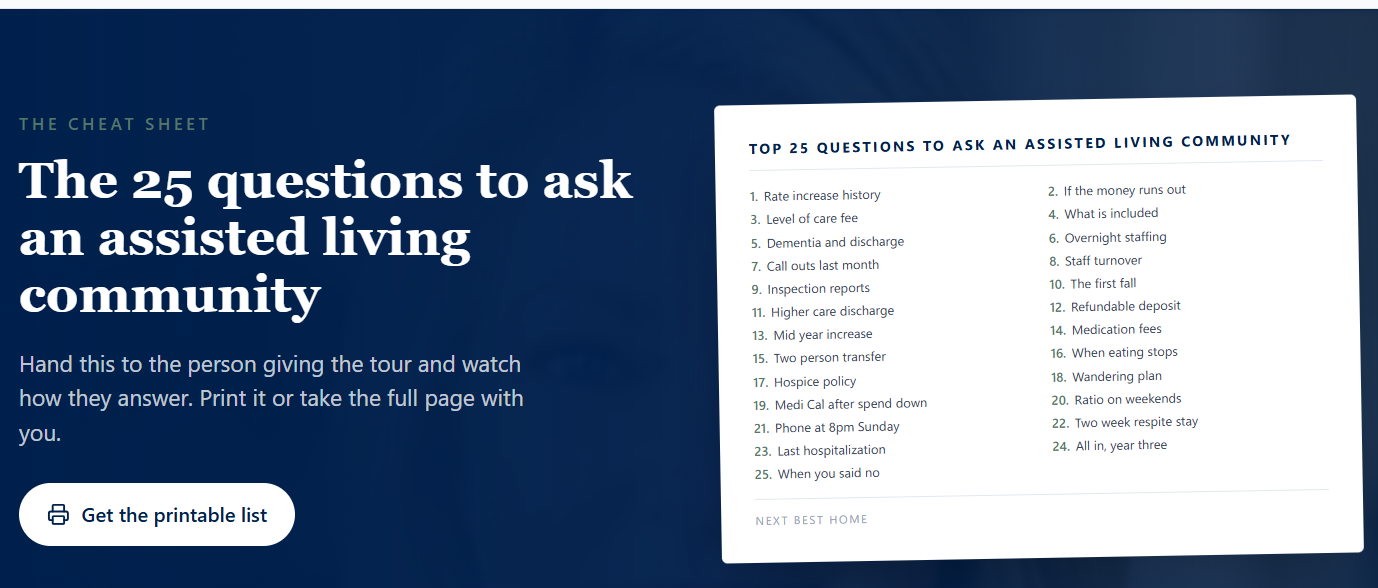
I was sitting in a living room on the Mesa in Santa Barbara with a daughter who had flown in for four days and a mother who did not want to leave her house. There was a binder. There were three quotes from three communities, all with a similar cover rate and wildly different care charges underneath it. Nobody in that room could tell me what the final monthly number would be. Not the daughter, not the mother, and not the three people who had handed out the quotes. That was the moment it came into focus for me, and it is the reason Next Best Home exists.

The movie title that got under my skin
Pain Hustlers is about pharmaceutical reps selling into a system that rewarded volume over care. That is not why I bring it up. I bring it up because we are in a new era of people making health and financial decisions for a parent, a spouse, or themselves, with almost no education to make them with. The machinery looked familiar. The pipeline. The quotas. The Monday call about where the referrals came from. The pressure to move a family to a decision before the family was ready. I am not going to pretend I was above it. I was good at it, and being good at it is exactly how you learn what it costs.
What is different about care hustling, and what people do not understand about this market, is that the product was never the problem. The problem is treating the family as the product. Their fear becomes the funnel. Their urgency becomes the inventory.
What it actually takes to build a reputation in a community
Everyone assumes it is relationships with the discharge planners and the case managers. That is where it starts. It is not the whole thing. A lot of referrals come out of the hospital and the skilled nursing facility, and they always will. Step back and there is a whole ecosystem around that bed: the elder law attorney, the financial advisor, a home health company, a senior living community, the marketers, the neighbor who has already been through it. The work that builds a reputation does not live in one silo. It lives in the community, and the community is the bottom line.
The thing is being the person who tells a family the truth when the truth costs you the sale.
- I have told people not to move. More than once.
- I have told a daughter her mother qualified at a lower care level than the community had quoted, so she was about to pay for hands on help nobody had ordered.
- I have walked a family away from a building because the staffing at night did not match the brochure.
I told just as many families to place a parent after rehab, because trying care at home likely was not going to be a long term solution. I referred to other options about as much as I got referrals for my own business, because I could, because my phone was always ringing, and because it was the right thing to do.
Santa Barbara is a small town in a beautiful coat. Do that two or three times and the right people start calling you first. Do it for twenty years and you are the person a care director phones on a Friday afternoon when a family has run out of options. That reputation is not built by marketing. It is built by being reachable, being honest, and being there after the sale, which is the part nobody puts in the training deck.
The job I wanted, and the job I turned down
I spent 20 years as a top producer at a home care company, starting in the early 2000s. Different world, different time. When a lot of things crashed in 2008, I prospered. When I started, a starting assisted living rate was a number people said out loud without flinching. I watched it change. I watched the referral business change with it, from providers calling each other because they trusted each other, to online aggregators and paid placement and call centers reading from a script.
Truth be told, what I actually wanted in those early years was to be a pharmaceutical rep. That job was glamorized in the late 90s and early 2000s in a way that is hard to explain now. Company car, expense account, a bag with your name on it, a conference in a nice city. Big money on a ladder you could actually see. Nobody in that room handed you a slide about the damage it would do a decade later, and I did not ask, because in your twenties the money is louder than the question. I had no real insight into any of it. I just wanted in.
Then the opportunity showed up. I interviewed with a company, and the pharmaceutical sales manager offered me the job. After all that wishing and hoping, I turned it down.
He told me I was making the worst mistake I would ever make. That is a lousy thing to say to a person who is choosing a different life than the one you picked for them, and it told me more about him than it ever told me about selling.
What I walked into instead was a home care company, where a manager handed me flexibility, support and room to be creative, the exact combination a person like me needs to thrive. I did not understand it then. Without knowing it, I had dodged pain hustling and walked straight into care hustling instead. And it was good. The first year was a love affair. Then it turns into the part nobody puts in the brochure. You get one taste of the win and you spend the next stretch chasing it. That is the dragon. It teaches you how to hit a number and quietly teaches you that the number is the person.
Right place at the right time pays once. Staying is the work. Staying through the years when a community changes hands, when the good care director leaves, when a family you placed two years ago calls back in a crisis. Anyone can be present for the boom. The reputation comes from being useful in the ordinary weeks.
The living room on the Mesa
I was sitting in a living room on the Mesa in Santa Barbara with a daughter who had flown in for four days and a mother who did not want to leave her house. There was a binder. There were three quotes from three communities, all with a similar cover rate and wildly different care charges underneath it.
Nobody in that room could tell me what the final monthly number would be. Not the daughter, not the mother, and not the three people who had handed out the quotes. That was the moment it came into focus for me, and it is the reason Next Best Home exists.
What families do not have a clear picture of
Cost. That is the answer. Families do not have a clear picture of cost, and much of the industry has little incentive to give them one.
Here is what people find out too late. The advertised base rate is not the bill, because care charges are assessed after move in, and the assessment is done by the people who benefit from the higher number. The price is not the same for two people in the same building, because care levels move with a hospital stay or a fall. And the house, the largest asset most families here own, is usually the thing that gets liquidated in a hurry, at the worst possible moment, with the least amount of information.
Now the part I have to say plainly, because I lived it. Families are not being referred into care by people who understand what care costs. They are referred by a discharge planner working a fifteen minute discharge with no idea what the care assessment will add to the bill. They are referred by a doctor's office, a neighbor, a case manager, a friend who liked one building. Good hearted people, almost none of them financially literate in this market, and not one of them able to sit down with that family and tell them the real number before they sign.
I was one of those people for twenty years. I could describe a community all day. I could lay out senior living community options or care plans at home. But I was the salesperson. I got paid to make money, to get referrals, and to get families on service. I could not, honestly, walk a family through what the money was doing, what the house was worth in that decision, or what equity they were about to burn. Financial literacy was never on the job description in senior care, so most of us never built it. The family is left to work it out in one of the most challenging times of their lives, from people who are guessing.
Families are being sent into the biggest financial decision of their lives by people who have not been taught the money part. I was one of them. I speak honestly from experience.
The part that keeps me up
Families in Santa Barbara sell homes they did not have to sell. Not because the care decision was wrong, but because nobody slowed it down long enough to look at the whole picture. In this market the risk is rarely a rushed sale price. It is the tax consequences nobody modeled, a capital gain that a trust or a stepped up basis might have handled differently, the property tax base a surviving spouse gives up the day they move, and a set of other options that never made it onto the table. For a lot of families the house is not just an asset. It is the anchor that lets the healthy spouse stay independent and keeps the cost of care from reaching the principal. Sometimes it is a rental that carries a long term care bill, month after month, without the family ever touching the asset itself. And sometimes it is simpler than that. A family just wants to keep the home in Santa Barbara. That is allowed. Sell it by default and a family can spend down something they never needed to spend, including a house they never wanted to leave.
There is a better sequence. Get the real monthly number, including care. Find out what the house can actually do for you before it becomes urgent, while you still have options and time. Decide with a team, not alone at 11pm with a search engine.
Why I built Next Best Home
I wanted the thing I wished I had in that living room on the Mesa in Santa Barbara.
- Costs in public, in local numbers, with the care charges included rather than buried.
- A vacancy directory the communities update themselves, so a family is not chasing stale listings.
- A team instead of a lead. A care advisor, a real estate specialist and a financing strategist in the same conversation, because those three questions arrive together.
Nobody at Next Best Home takes a placement fee from a community. That is the whole design. If we point you somewhere, it is because it fits, not because it pays. Being free of that incentive is worth more than any ad budget, and it is the only way this stays honest as it grows.
Which is why I wrote Senior Cares
The book came from the same place. After my first nine years on the sales side of this industry, I had things to say that do not fit in a brochure. I published it in 2013.
In Senior Cares, Jessica Solomon pulls back the curtain on the senior care industry with raw honesty and insight. As a seasoned sales professional, Jessica spent over two decades navigating the pressure filled world of client goals, referral quotas and hustling, only to discover something unexpected along the way: humanity.
This is not your average book about caregiving. It is a behind the scenes look at the business of senior care, from the push to get clients to the emotional reckoning that comes when you meet the people behind the paperwork. Heartfelt stories, candid observations, and the occasional dose of dark humor.
The hustle I would defend
I am not against hustle. I am against hustle pointed at the wrong person. The version I would defend is unglamorous and slow. Answer the phone on a Saturday. Learn what a care level actually costs and say it out loud. Tell a family the truth when it sends them somewhere else, and then pick up when they call you two years later anyway.
In a town this size, that is not a marketing strategy. It is just how you live here. And it is the only kind of care hustling I am willing to put my name on.
If you are in the middle of this right now, start with the number. No, it does not all get easy once you know what you are actually deciding. But more things fall into place once you do. They say it takes a village. I say it takes a team of trusted advisors.