Twenty years ago, touring a senior living community was a pleasant afternoon. There was a piano player in the lobby, a calendar of activities on the wall, and a brochure with a photograph of people doing tai chi on a lawn. Families asked about amenities, activities, scheduled transportation, and the monthly rent. Then they signed.
That list is still the list most families bring. It is also the reason so many of them are back in a lawyer's office two years later.
What the tour used to be
In 2005 the highest rent in town bought the most. Communities competed on the size of the apartments, the number of outings, the movie theater, the ice cream parlor. Care was assumed to be a fixed thing, like the carpet. The rate went up on a schedule that nobody questioned because the increases were small and the equity in the house was large.
None of that holds now. Care got unbundled from rent. Rates moved faster than retirement income. Staffing tightened. And the average resident arrived older and more medically complicated than the same building saw twenty years earlier, which means the questions have to change.
The 25 questions, then and now
Read down the left side and you will hear 2005. Read down the right side and you will hear what actually protects your family.
- 2005: Do you have a salon or barber on site?
Ask now: What is your rate increase history, and how much notice do you give before one? - 2005: How many activities are on the calendar each week?
Ask now: If my mother runs out of money in year four, what happens? Do you discharge her? - 2005: Is there scheduled transportation to church and the market?
Ask now: Is there a level of care fee, and what exactly triggers the jump? - 2005: What is the monthly rent?
Ask now: What is included in that number, and what gets billed separately? - 2005: Is there a pool or an exercise room?
Ask now: Can you accommodate dementia, and at what point do you ask a family to leave? - 2005: Is there a private dining room for family dinners?
Ask now: Who is on the floor overnight, and what is the staffing after 10pm? - 2005: How big are the apartments?
Ask now: How many caregivers called out last month, and who covered those shifts? - 2005: Do you run a bus for outings?
Ask now: What is your staff turnover, and how long has the administrator been in the building? - 2005: Can we see the activity calendar for last month?
Ask now: Can we see your last three licensing inspection reports, unedited? - 2005: Is housekeeping included weekly?
Ask now: What happens the first time she falls? Who calls 911, and who calls me? - 2005: Is there a beauty shop on the property?
Ask now: What is your discharge policy when someone needs a higher level of care? - 2005: Is cable television included?
Ask now: Is the deposit refundable, and what eats it? - 2005: What is the deposit to hold a room?
Ask now: Under what conditions can you raise the rate in the middle of a year? - 2005: Is there a waiting list, and how long is it?
Ask now: What do you charge for medication management, and is it per medication? - 2005: Do you have a fitness center?
Ask now: Can you handle a two person transfer? If not, who can, and where do we go? - 2005: Are meals restaurant style?
Ask now: What do you do when a resident stops eating? - 2005: Do you host a happy hour?
Ask now: What is your hospice policy, and do you allow it in house? - 2005: Is there a garden or a walking path?
Ask now: What is the plan the night a resident wanders out the door? - 2005: Can residents keep a car?
Ask now: Do you accept Medi Cal after a spend down, or are you private pay only? - 2005: What is your staff to resident ratio?
Ask now: Is that ratio the licensing minimum or your practice, and does it hold on weekends? - 2005: Do you have Wi Fi in the rooms?
Ask now: Who actually answers the phone at 8pm on a Sunday? - 2005: What happens on weekends, activity wise?
Ask now: Can we do a two week respite stay before signing anything? - 2005: Do you have a library and a card room?
Ask now: What did you do the last time a resident was hospitalized? Who held the bed? - 2005: Is there a patio residents can use?
Ask now: What is the real all in number in year three, care and fees together? - 2005: What makes your community special?
Ask now: When was the last time you told a family no, and why?
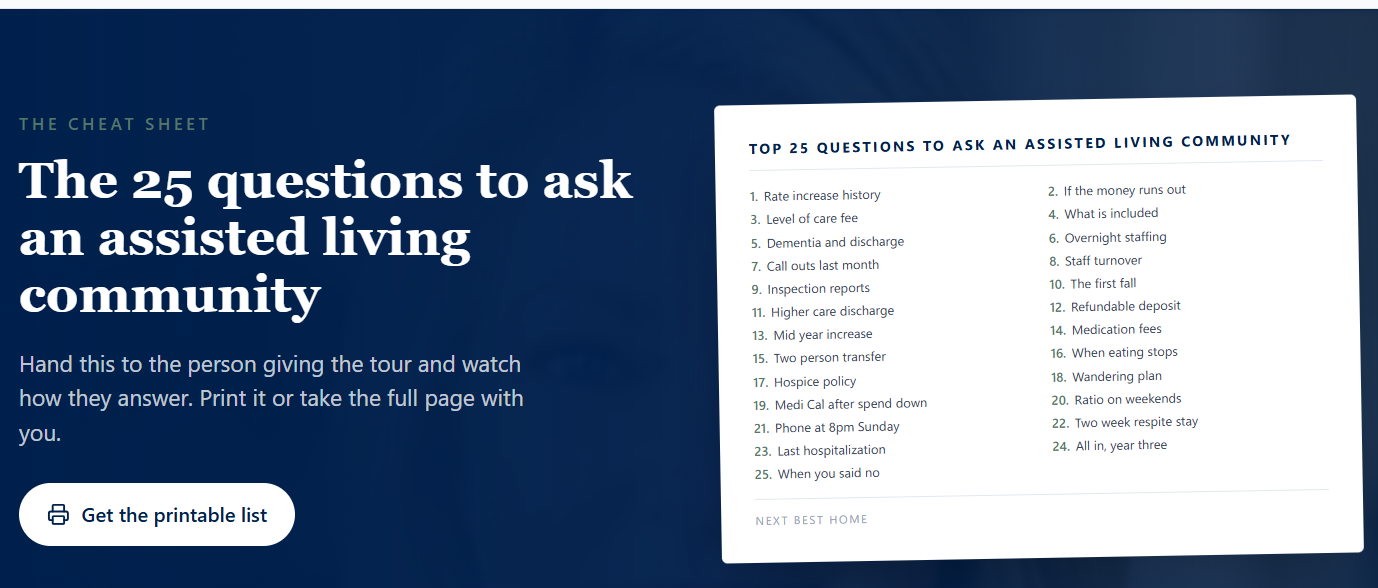
Print the list. Hand it to the person doing the tour. Watch how they answer the ones on the right.
The four that decide the next ten years
Rate increases. Ask for the last five years in writing, not the last twelve months. A community that has been raising rates 8 percent a year has doubled its rate in nine. Our local survey for September 2026 shows starting rates from $2,000 a month in the smallest residential care homes to $11,750 in the largest communities, with the typical starting rate around $7,000. Twenty one of the 48 communities we track reported an opening. Add ten years of increases to any of those numbers and the arithmetic stops being theoretical.
Running out of money. This is the question families avoid because asking it feels like admitting something. Ask anyway, early, in the first visit. What happens in year four if the money is gone. Is there a spend down to Medi Cal, do you accept it, and what is the discharge policy if you do not. Get it in writing. A verbal reassurance from a marketing director is worth exactly nothing in year four.
Dementia. Ask whether the community can keep a resident as cognition changes, and where that resident goes when it cannot. Memory care in this market runs around $9,000 a month against roughly $7,000 for assisted living. That gap is a separate financial plan, and it should be a separate line in the family budget before anyone signs a lease.
Caregiver availability. Not the ratio. The roster. Who worked the overnight shift last Saturday. What happened the last time two caregivers called out on the same day. Whether the administrator has been in the building long enough to know every resident by name without looking. Care is delivered by people, and the people part is the part that search engines cannot measure.
Why the old list feels safer
The amenity questions have answers. The new questions have implications. That is why families gravitate to the salon and the bus schedule, and why the tour guide, who is paid to keep the conversation pleasant, is usually happy to let them stay there.
We put all 25 on one page so you can carry it in. Print it, or save it to your phone. If a community cannot answer the right hand column with specifics, that is your answer about the community.
Move fast on the care. Move slow on everything that touches the house.
The printable version is here: The 25 questions cheat sheet. For the money side of the same decision, start with our Santa Barbara care cost calculator and then look at who has an opening on the local vacancy list.