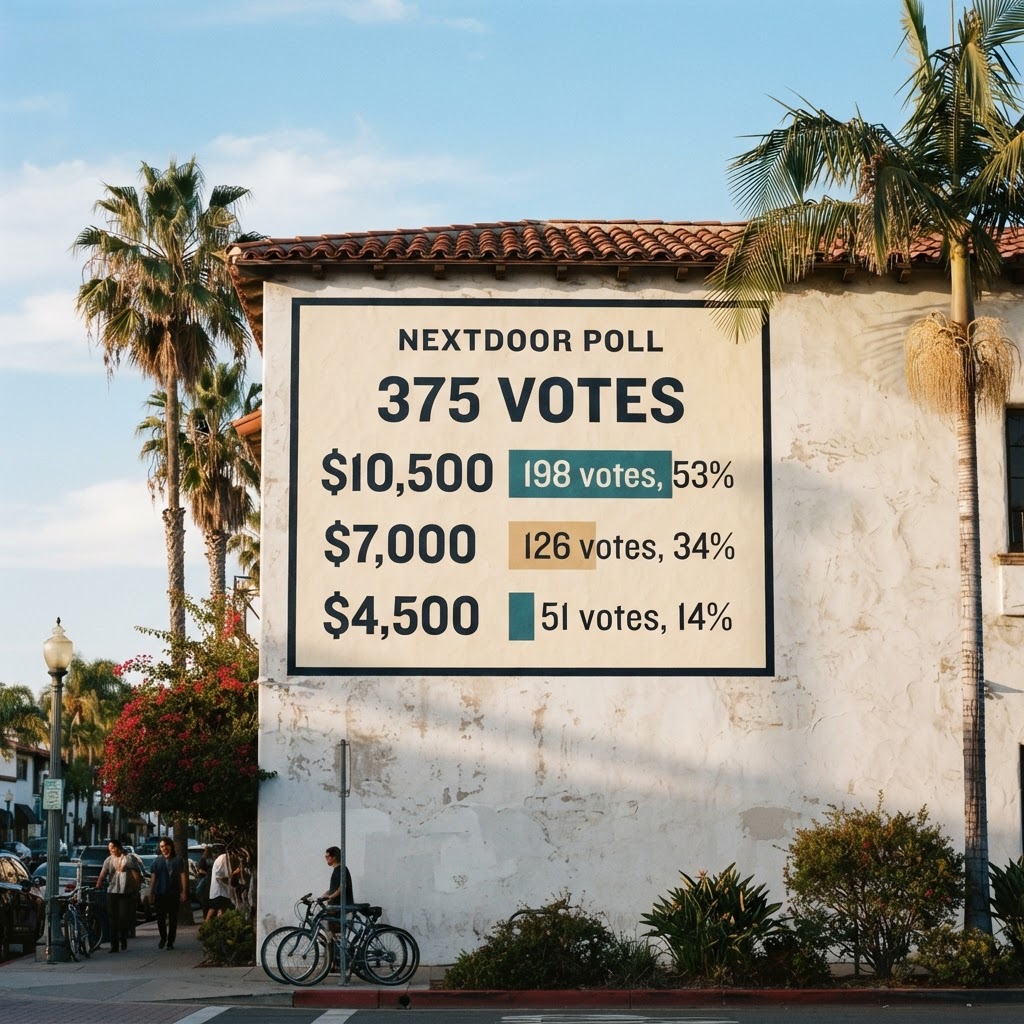
I asked my Santa Barbara neighbors a question on Nextdoor: what is the median monthly cost of assisted living in a community or care home here, $4,500, $7,000, or $10,500?
375 people voted. 198 chose $10,500, a little more than half of everyone who took the time. 126 chose $7,000. The remaining 51 went with $4,500.
The $7,000 answer is the one our own September 2026 survey of 48 local communities supports. It is also the answer fewer than one in three voters picked.
That gap is the story. Not who was right, but why so many neighbors expected a number that our survey does not show, and what that tells a family trying to plan.
The poll, plainly
A Nextdoor poll is not a scientific survey. It is a self selected group of people who care enough about the question to click, and that is a real limitation. I am not presenting it as data about the market. I am presenting it as data about what people believe, which is a different and useful thing.
What people believe is this: assisted living in Santa Barbara is a five figure monthly decision. More than half the neighbors who voted are braced for $10,500.
Both numbers are true, and that is the problem
Here is the part that matters most, and the part a single number can never carry. $7,000 was the median starting rate. It was not a promise about what a family's bill will be.
A starting rate is the front door number. It is what a community quotes before anyone has met your mother, read the assessment, or looked at which room is available. It is a real number, honestly collected, and it is not the invoice.
Which means the neighbor who guessed $10,500 is not confused. That neighbor may be the one with a parent already living it, paying for the care level that a starting rate does not include. Families in that position do not need to be corrected. They need the rest of us to stop pretending the first number is the whole number.
What a starting rate leaves out
Two people can move into the same community on the same day and pay different amounts. Here is what moves the bill:
- Level of care. Most communities price tiers of help with bathing, dressing, medication and mobility. The starting rate usually assumes the lightest tier, or no tier at all.
- Incontinence care. Frequently a separate charge, and frequently a meaningful one.
- The room. A shared room, a private studio and a one bedroom with a view are three different prices in the same building.
- The move in fee. A one time community fee that never appears in a monthly comparison.
- Extras. Second person fees for couples, medication management, transportation, salon, guest meals.
- Time. Rates change. Care needs change. A quote from this month is not a contract for next year.
That is why I would not tell a family to build a plan around $7,000. It is a fine place to start the conversation and a terrible place to end it.
Which Santa Barbara number do you mean
There is a second reason the answers spread out, and it has nothing to do with anyone being wrong.
Our September survey covered 48 communities in the broader local directory and found a $7,000 median starting rate. A separate, narrower Santa Barbara city snapshot lists a $7,500 median among 33 communities. Same area, different boundaries, different set of buildings, different date, two honest numbers.
So when someone asks what assisted living costs in Santa Barbara, the answer depends on which Santa Barbara they mean and which communities got counted. Anyone who quotes a single figure without saying where it came from has skipped the only part that makes it checkable.
The questions worth asking instead
The poll told me neighbors are ready for a more useful conversation than "how much is assisted living." These are the questions that actually produce a plan:
- What is the starting rate at a community that has an opening right now?
- What will my parent pay for the care they need today, not the lightest tier?
- Which of these charges could increase later, and by how much?
- How will we cover the monthly cost without making a rushed decision about the family home?
Those four answers turn a range into a budget. The range was never the hard part.
What to do this week
Start with the local assisted living listings, which show which communities reported an opening and the rate each one gave us. Then run your own hours and care level through the care cost calculator to see how the monthly number behaves when needs change. If you want the wider context first, the assisted living cost guide walks through what is included and what is billed on top.
Before you commit to anything, ask each community for a written estimate based on your loved one's actual needs, not the brochure rate. Ask what would make that number go up. A community that answers those two questions without flinching is telling you something useful about how the next few years will go.
Cost clarity is the whole job
Smart decisions are made with cost clarity. The poll gave us a starting point and a little humility: half of us expect the higher number, and the honest answer is that both numbers live in this market.
The real work is finding out what care will cost your family, in writing, at the community you are actually considering. That is a conversation worth having, and it is the one I have with families every week.
I am not a placement agency and I take no fee from any community in that directory. My only fee in this work is a real estate referral fee when a family home is sold. How I am paid, and what this data covers.