Ask three questions of any senior care advisor, and the answers tell you everything. What is the FULL cost? Who gets paid? What happens when the money runs out? If the person across the table cannot answer all three in plain numbers, they are not working for you. They are working for whoever pays them, and in senior care that is usually the community, not your family.
What is Next Best Home?
Next Best Home is a Santa Barbara based senior care advisory built by Jessica Solomon, who has spent over 20 years in home care. It exists for one reason: families deserve real numbers and a local team before the crisis decides for them. Next Best Home helps families understand what care actually costs, whether they can afford to stay in their own home, and what their options are before they sell the house, because selling is the last option, not the first.
How "free" senior care help actually gets paid
Most families searching for care online meet a "free" advisor, a "free" placement service, or a "free" helpline. Free to the family, but not free.
Placement and referral fees in senior care commonly run $2,000 to $10,000 or more per move-in, paid by the community to the advisor or the platform that sent the family. That is why so many senior care websites will not show you a price. The business model is pay to play, and the system is confusing by design: if you cannot see the numbers, you cannot compare them, and if you cannot compare them, you take whatever you are offered.
When the advisor's paycheck depends on where you move, the advice follows the money. That is the single most important thing to understand about searching for senior care.
What the Federal Trade Commission says about the word "free"
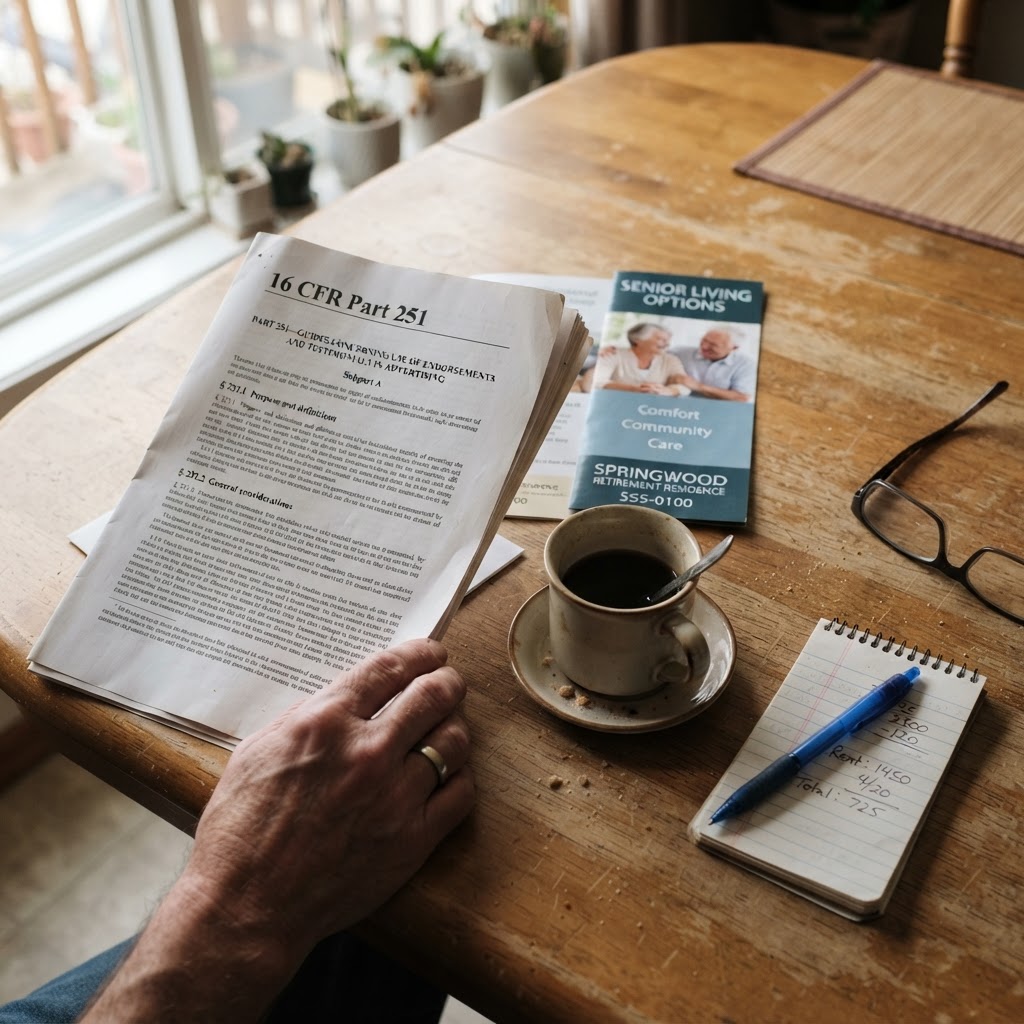
This is not a marketing opinion. The FTC keeps a rule on the books for this exact word: the Guide Concerning Use of the Word "Free" and Similar Representations, at 16 CFR Part 251. The rule says that when a business offers something as free, every term and condition for getting it and keeping it has to be stated clearly and conspicuously at the outset of the offer, so there is no reasonable chance the terms could be misunderstood.
Now hold that standard up against the senior care advisor ecosystem. A placement service that charges the family nothing and collects $2,000 to $10,000 from the community after the move in is advertising a free service whose real terms never get said at the outset: who pays, how much, and that the list of communities is limited to the ones that pay. The family hears free. The business means free to you, paid by someone else, from a list we choose. Those are two different offers wearing the same word.
Under the guide, those hidden terms are the terms of the offer. Who pays the advisor, how much they receive, and the fact that your options are narrowed by payment are the conditions a family needs in order to understand what is on the table. When those facts only surface after the paperwork, the word free did the work of a sales pitch and the family never got to weigh the trade.
Free to you is not the same as free. If the money moves behind a wall, the word free is describing the wall.
What that means in practice is simple. Treat free as a disclosure question, not a price. Ask who gets paid, how much, and whether the recommendation list is filtered by who pays. A service that answers all three is being straight with you. A service that cannot answer has not met the basic standard the federal government sets for the word, and it should not get your parent's paperwork.
Three questions to ask any senior care advisor
1. What is the FULL cost?
Not the starting rate. The full monthly cost, at the level of care your parent actually needs, including care fees, medication management, and everything that gets added later. If they cannot give you a number, they do not have one, or they do not want you to have it.
2. Who gets paid?
If someone is helping you for free, ask who pays them and how much. A trusted advisor answers this directly. If the answer is vague, the payment is coming from somewhere you cannot see.
3. What happens when the money runs out?
Care is a runway question, not a price question. A family needs to know how many months or years their money lasts at a given level of care, and what changes when it does not. Anyone who skips this question is selling a move in, not a plan. See the honest version of paying for care.
What care actually costs in Santa Barbara, California
These are real, current local numbers, the kind most websites will not publish.
- Home care: $38 to $65 per hour in Santa Barbara, with most agencies at $43 to $50 per hour. A private registered nurse runs $100 to $250 per hour.
- Four hours a day at $45 per hour costs about $5,400 a month. Eight hours a day costs about $10,800 a month.
- Assisted living: the median is about $7,000 a month, and in Santa Barbara the average is $7,500 a month or more.
- The break even point: at roughly five hours of home care a day, staying home costs about the same as assisted living. Below that, home is usually cheaper. Above it, it is time to compare honestly.
Most families do not understand the cost of care. But the big mistake is selling the real estate. The house is the financial anchor, the thing a family worked for and planned to keep. Do the math before selling it. Run your own numbers here.
What Next Best Home does differently
- Real numbers first. Every recommendation starts with what care actually costs, in Santa Barbara and California, not a national average and not a "starting at" teaser.
- Local advisors, not a call center. Next Best Home is a team of trusted local advisors who know the Santa Barbara market, the communities, the waitlists, and the agencies, because they work in it every day.
- Home first. Next Best Home was always about helping people stay in their own homes. Home care is where the math usually works, and where families want to be.
- Transparency as the product. Who gets paid, how much, and what happens when the money runs out, answered in plain language, before any decision.
Clarity is kindness. Transparency is the new trust.
Frequently asked questions
Why is it so hard to find senior care prices online?
Because most of the sites that rank for senior care searches are paid to send families to specific communities. Publishing real prices would let families compare, and comparison is bad for a pay to play model. So prices stay hidden, and families are told to "call for pricing."
Should I sell my parent's house to pay for care?
Not first. Selling the house is the last option, not the first. Run the numbers on home care first: at four hours a day, home care costs about $5,400 a month at $45 an hour. Compare that with the assisted living median of about $7,000 a month. Know your options, and speak to local care experts, before selling the financial anchor.
How do I know if a senior care advisor is trustworthy?
They give you real numbers without being asked. They tell you who pays them. They answer what happens when the money runs out. And they are local. They know the market you are actually deciding in, not a national database.
Is a senior care advisor allowed to call their service free?
Free is regulated advertising language, not just a friendly word. The FTC's guide on the word free requires the terms and conditions of a free offer to be clear and conspicuous up front. An advisor paid by the community should say so plainly, along with how much the fee is and that the community list is shaped by who pays. When those terms stay hidden, the family is not getting a free service, only an undisclosed one. Read the FTC guide.
Who is Jessica Solomon?
Jessica Solomon has lived in Santa Barbara since 1995 and has worked in senior care since 2004, spending over 20 years in home care marketing. She built Next Best Home after watching families sell houses to pay for care, wait until the last minute, and run out of money, because no one had ever shown them the real numbers.
Stop comparing communities. Start comparing futures.
Next Best Home. Trusted advisors. Keep it local. Keep it in the community. Call 805-883-8800 or start with the numbers.