
After more than 20 years working with families navigating aging and care, I keep seeing versions of the same story.
It almost never starts with:
"We need to make a major financial decision about Mom and Dad."
It starts with something smaller.
Mom falls.
Dad stops driving.
Someone notices the refrigerator is empty.
A hospital discharge suddenly requires help at home.
One sibling thinks everything is fine. Another is sounding every alarm.
And then the dominoes start falling.
Declining parent → Safety concern → Caregiving pressure → Family disagreement → Care decision → Cost shock → "How are we going to pay for this?" → The house → Major financial decision
This is the part I don't think families are prepared for.
The problem isn't simply finding senior care.
Families think they're trying to answer one question:
"What kind of care does Mom need?"
They're not.
They're about to answer a whole series of questions that affect each other.
Can Mom still live safely at home?
If she stays home, how much help will she need?
What does that help actually cost?
Would assisted living cost less?
Does Medicare pay for any of it?
How long will her savings last?
Who is going to manage everything?
Then comes the question that can completely change the family's financial picture:
What do we do with the house?
Sell it?
Keep it?
Rent it?
Use the equity?
Repair it first?
Can Mom afford to remain there?
What happens if we sell it and later realize we didn't need to?
These aren't separate conversations.
They're one decision cascade.
Too often, families don't understand the financial implications until they're already several decisions into it.
Pressure changes the way families make decisions.
When Mom is being discharged from the hospital, everyone wants an answer.
When a caregiver is exhausted, everyone wants relief.
When the care bill arrives, everyone wants money.
When siblings disagree, everyone wants the problem resolved.
That's human.
But urgency can turn a temporary problem into a permanent financial decision.
A care plan can change.
A caregiver can change.
An assisted living community can change.
Selling the family home is considerably harder to undo.
That is why families need some basic financial literacy around aging before the crisis.
I'm not talking about becoming a financial expert.
I'm talking about understanding the basics.
What does care actually cost?
What resources are available?
What does insurance cover?
What doesn't Medicare cover?
How long will current assets last?
How much equity is in the house?
What role could the house play in paying for care?
What are the financial consequences of selling it?
Who should be part of the conversation before a major decision gets made?
Cost clarity changes the conversation.
This has become one of the central ideas behind Next Best Home.
You can't make smart care decisions without cost clarity.
Telling a family Mom needs care without helping them understand what that care costs is only half the conversation.
Showing them assisted living options without helping them understand whether those options are financially sustainable is only half the conversation.
Talking about selling the house without understanding the care plan is only half the conversation.
Care, housing and money are connected.
Yet families are routinely forced to navigate them in completely separate silos.
A doctor talks about health.
A home care company talks about care.
A senior living community talks about housing.
A financial professional talks about money.
A real estate professional talks about the house.
An attorney talks about the legal structure.
Meanwhile, the family is standing in the middle trying to figure out how all of those pieces fit together.
That is the problem.
We need to catch families earlier.
The best time to understand these questions isn't when Mom is sitting in a hospital bed waiting to be discharged.
It's when you first start thinking:
"Something is changing."
That's the window.
Ask the uncomfortable questions.
Understand what care costs where you live.
Know what your parents have.
Understand the house and the equity in it.
Learn what Medicare does and does not cover.
Talk with your siblings.
Know who has legal authority.
Understand which decisions can be changed later and which ones can't.
You don't need every answer.
You need enough clarity to avoid making the biggest decisions under the greatest pressure.
That is what we're building at Next Best Home.
Not another place telling families what decision to make.
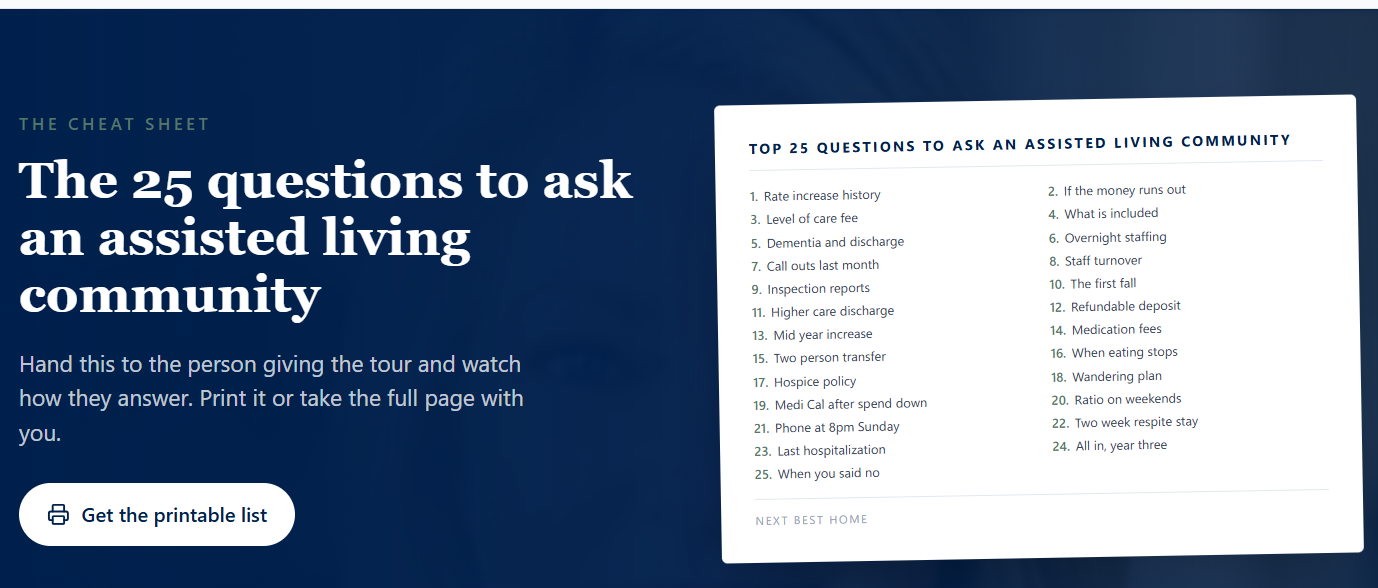
A place helping families understand what problem they actually have, what questions they should be asking, and what they need to know next.
Before the fall.
Before the hospital discharge.
Before the care bill.
Before someone says:
"I guess we have to sell the house."
Start earlier.
Get clarity. Then make the decision.
Clarity is kindness.