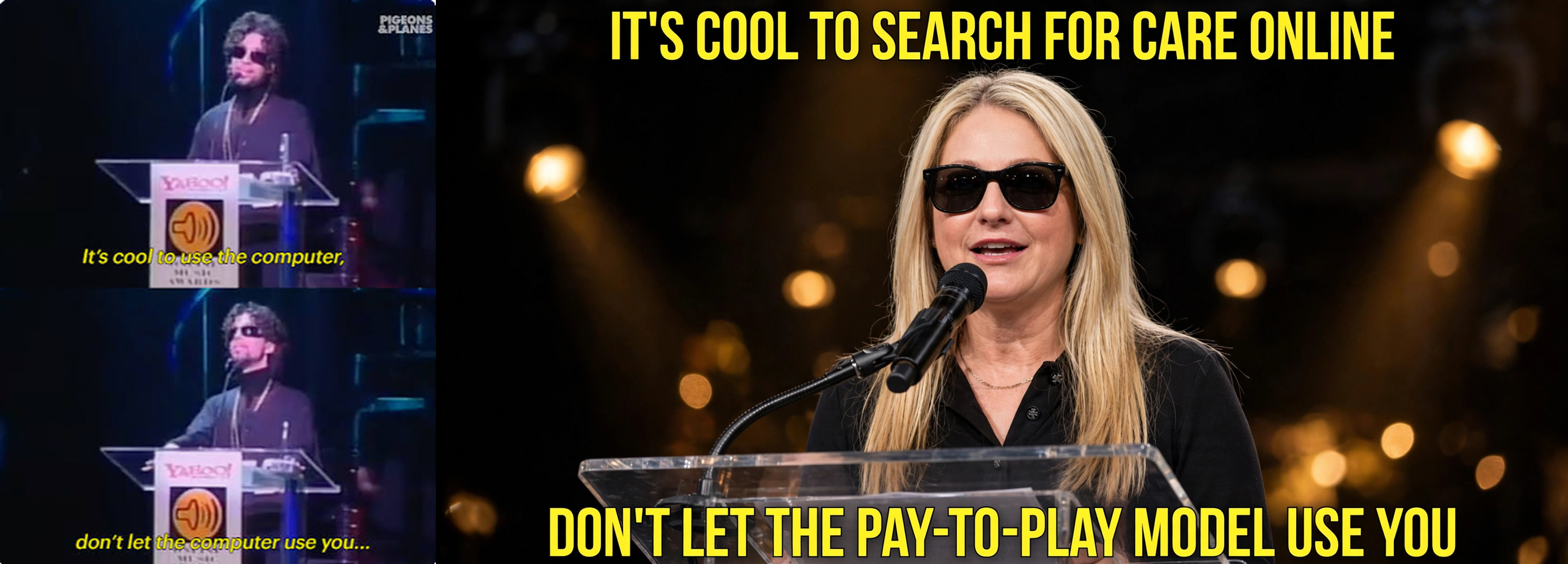

You would not buy your tomatoes from a guy in a warehouse in another state and call it local produce. So why is the most expensive decision in your family's life still being made from a search box?
Here is the picture. Saturday morning at the farmers market on Cabrillo. You walk past the guy who grows the peaches, and he hands you a slice because he wants you to know what a peach is supposed to taste like. He can tell you which field it came from, when it was picked, and why this week is better than last week. That is not marketing. That is proximity. Somebody standing next to the actual thing, with their name on it, in your town.
Now watch what happens when a parent needs care. The whole family goes indoors, opens a laptop, and starts asking a company two time zones away which community in Santa Barbara is right for a woman who has lived here since 1978, has $480,000 of equity in a house on the Mesa, and needs a place that will take her small dog.
That is the swap I want to put on the table. We trust the person at the market with the food going into our bodies, and we trust the paid placement machine with the money that is supposed to keep our parents safe for the rest of their lives. One of those decisions is reversible. The other one is the family's last financial anchor.
Organic is a claim. Local is a fact.
Organic is a label somebody pays to be inspected for. Local is a thing you can verify by driving there. Yet we have trained an entire generation of caregivers to treat information as trustworthy because it ranked on page one, which is the opposite of verification. Ranking is not accuracy. Ranking is budget.
I have watched this play out for years now. Families arrive with screenshots from national care sites, numbers that were averaged across a state the size of a country, and a shortlist of two communities that both happen to be paying that site for placement. Then they walk into a small six bed board and care home three blocks from their mother's church, one that has an opening this month and a rate $2,000 a month below the quote they were given, and they are genuinely surprised it existed. It existed the whole time. It just was not for sale to the aggregator.
Ranking is not accuracy. Ranking is budget.
What the internet actually knows about Santa Barbara
Almost nothing current. Here is what our own local survey of 48 Santa Barbara communities found for September 2026. Starting rates run from $2,000 a month in the smallest residential care homes to $11,750 in the largest communities. The typical starting rate sits around $7,000, with an average of $7,139. Twenty one of those communities reported an opening. Nineteen offer a respite stay. Twenty four take pets.
The details that actually decide this are not in the search results. Who answers the phone at 8pm, how the dining room feels when nobody is touring, and which administrator has been in the building long enough to know every resident by name. That information lives in the community, with people who can be checked on, not in a database built to sell leads. Those facts live in the community. They do not live in a database that was built to sell leads.
Same story on home care. Rates here run $38 to $65 an hour, averaging about $45, which is $8,574 a month at 44 hours a week. Statewide averages hide the fact that a caregiver who can drive from the Eastside to Carpinteria in the same afternoon is worth more than an agency three counties away, and that the cost of that drive is baked into the rate either way. You can check the real numbers on our Santa Barbara care cost calculator, which is built from this market, not from a national survey.
The advisor two time zones away
Somebody can be licensed, articulate, and completely unable to answer your question. Ask a remote advisor what a small home on the Mesa actually looks like at 7pm, when the dining table is set for six and everybody is watching the same game, and you will get a brochure. Ask a local one and you will get an opinion, a story, and the name of the administrator's daughter.
This is the part that gets called bias. It is not bias. It is context. A local advisor knows which buildings have new management, whose memory care director just left, which community will not take a resident who wanders, and which one quietly does the hard work well without advertising it. That knowledge comes from attending the same funerals, sitting in the same hospital discharge meetings, and running into the same families at the grocery store for a decade. No amount of content marketing substitutes for being physically present when something goes wrong.
Ask a remote advisor what a small home is like at 7pm and you get a brochure. Ask a local one and you get the truth.
The part that makes this urgent
Here is where I stop being polite. The decision about where a parent lives is wired directly to the family's last financial anchor, and that anchor is almost always the house. When you start with an internet shortlist, you start with the most expensive options, because placement fees are earned on rate. Ten thousand dollars a month instead of seven thousand is not a rounding error. It is $36,000 a year, which is roughly what the family was hoping to leave behind, spent because a search result was ranked rather than verified.
That is why we built a local vacancy list of Santa Barbara communities with current rates, openings, pet policies, and respite availability. Nobody pays to be on it. The small home with four beds and a garden gets the same row as the big community with a fountain. That is what an organic lead looks like. Not a lead at all. A list.
Five questions that separate local from loud
Who pays you, and how much? Which communities on my list have paid you in the last year? How many of these buildings have you personally been inside in the last 90 days? Which one would you send your own mother to, and why not the other one? And who is the person I call at 9pm if this goes sideways?
Ask those five on the phone before you share your name, your email, or your mother's diagnosis. A local advisor answers all five without breathing hard. A call center reads you a script.
Change it in your own town
The fix is not a better algorithm. The fix is the same one that made the farmers market crowded on a Saturday while the supermarket aisle sat empty. Talk to people who live where the decision lands. Call the community directly, ask what an actual check would cost this month, and then go stand in the lobby and watch how people are treated when nobody is selling anything.
And when someone asks you where their mom should live, do not send them a link. Tell them what you know. Be the guy handing out the peach slice.
Move fast on the care. Move slow on everything that touches the house.
If you want a second set of local eyes on your numbers before you commit, our advisors sit in this market every day. You can meet them here, or start with the financing options families here actually use.