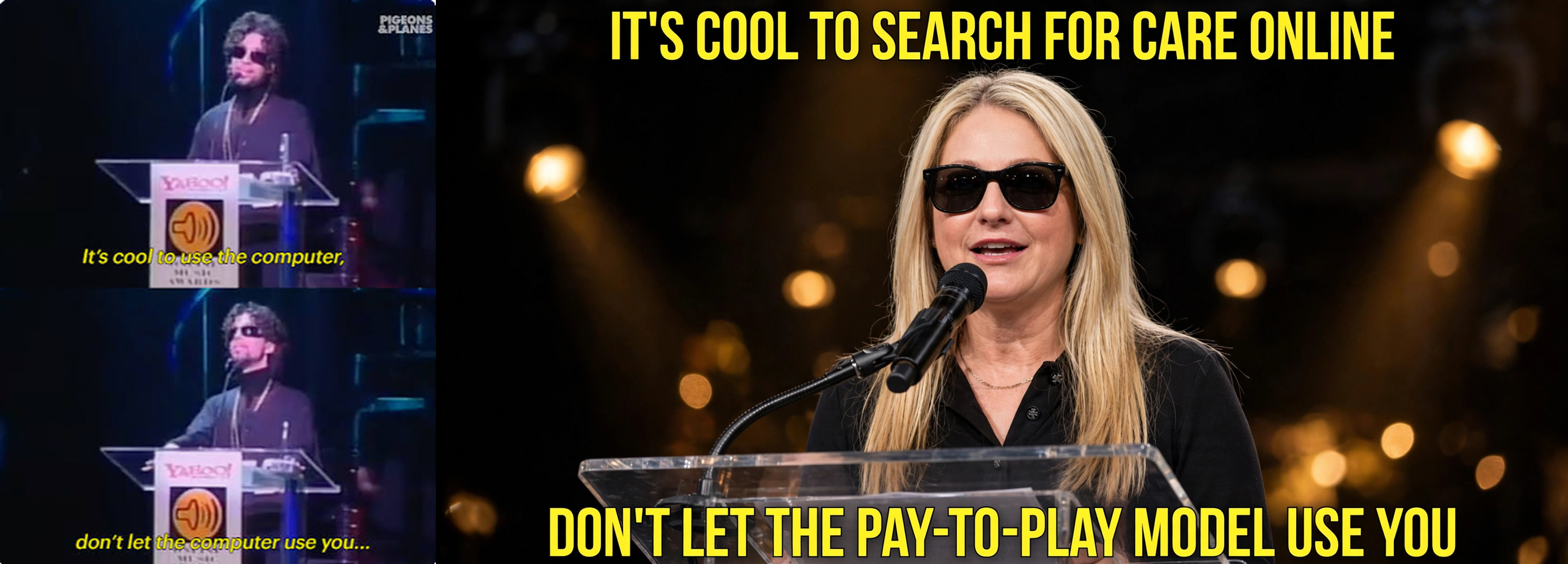

You did not learn how to fix a carburetor from a banner ad. You learned it from a guy named Dom who had a garage on the corner and never once asked for your email address in exchange for a quote. Same with the best burrito in town. Same with the plumber who actually shows up. Same with the dentist your entire street uses and the guy who can pull a dent out of a car door for forty bucks.
So explain to me why, the moment a parent needs care, we all become strangers to our own neighborhoods and start typing best assisted living near me into a search box that was sold to the highest bidder.
That is the shift I want to talk about, because I think it is already happening and almost nobody in the senior care business has priced it in. Word of mouth is coming back. Community feedback is coming back. Trusted local resources are coming back. The paid placement machine, the one that trained a whole generation of families to begin with the internet, is about to get filed under the same label we already use for everything else that arrives pre packaged and pre approved. Synthetic information. Noise with a phone number.
The Pay to Play Nobody Says Out Loud
Here is the part families do not hear until it is too late. The big referral sites are free to you and very much not free to the communities they recommend. Somebody pays for that placement. It is not your mother. It is the building.
Ask the next company that offers to find you care how they get paid. The honest ones will tell you. Placement fees in this industry can run a full month of rent or a healthy percentage of the first year. That does not automatically make anyone a villain. It makes them a business with a ranking to sell, and a ranking is not a recommendation. It is inventory.
In 2024 a Senate inquiry looked at the families who moved into assisted living through major referral services and found that nearly 40 percent of them landed above the budget they originally gave. For memory care, that number hit 55 percent. Read that again. The service built to narrow the search widened the spend.
Why a National Algorithm Cannot Find Your Mother a Room
Care is local in a way that almost nothing else in your life is. Two buildings three miles apart, same category, same marketing language, same stock photo of a smiling aide holding a teacup. One is clean, warm and staffed by people who know the residents by name. The other runs on agency shifts and smells like a hallway nobody opens a window in.
Now look at the money in this town. Our September 2026 survey of 48 Santa Barbara communities found monthly rates from $2,000 to $11,750, an average of $7,139 and a median of $7,000. Twenty one of those communities reported an opening. Nineteen offer respite stays. Twenty four accept pets. Independent home care averages about $45 an hour, which runs to roughly $8,574 a month at 44 hours a week. Memory care sits around $9,000. Private skilled nursing is about $13,500 a month.
That spread is the entire story. Same town, same need, a five figure difference, and the deciding factors are subjective, human and almost never in a database. Who answers the phone at 7 am. Who actually has a bed this month. Which building lets a husband stay for dinner every night without charging him for a guest meal. A national directory cannot feel any of that. The woman two doors down who toured six buildings in one weekend can.
Word of Mouth Never Left. It Just Stopped Being the First Stop.
Here is what makes community feedback different from a review page, and it is not sentimentality. It is skin in the game. When your neighbor sends you to a mechanic who lies, that neighbor has to see you at the mailbox on Saturday. Reputation costs them something. An algorithm does not have a reputation. It has a revenue model.
Step into any local Facebook group in Santa Barbara and watch what happens when somebody asks about care for a parent. You get names. Actual names of aides who answer their phone. You get a daughter who says, we used this place and here is what the contract did not cover. You get a plumber who fixed a grab bar for ninety dollars. That is not nostalgia. That is a functioning market with accountable participants.
Meanwhile, the internet is filling with articles about senior care that were never in the same room as a senior, written to rank, published by companies that make money when you click the ad next to them. Gen X has the best nonsense detector in America. We grew up with commercials between cartoons and learned to smell a pitch by the time we were nine. We can feel the difference between a person who has been there and a page that was assembled to look like one.
The Comeback Has a Shape
So here is what I think the next five years look like in this business. Families will stop beginning with the internet and start beginning with the people who already walked the road. The referral sites will not disappear, but they will get read the way we read anything paid and polished, as a starting point with a motive. And the local expert who answers the phone, knows the buildings by name and can tell you which one has a waiting list and which one has a problem, becomes the most valuable person in the conversation again.
That is the whole premise of this site, and it is why we publish the boring numbers. The community listing carries real rates and real openings for the buildings in town. The cost calculator runs your own hours and your own level of care instead of a national average. Trust plus numbers. Without the numbers, trust is just another ad.
What to Do With This Before the Crisis Hits
Ask three people, not one. The first recommendation you get always has a business model behind it. Three independent people who have actually placed a parent will tell you whether the first one was real.
Ask what they paid, and then ask what they paid extra for. Care bills routinely grow after move in, and nobody volunteers that part on the tour.
Run the local numbers before you walk into a building. Know that assisted living here typically starts around $7,000 a month, memory care around $9,000, private skilled nursing around $13,500 and home care near $45 an hour. Knowing the range changes how you hear a sales pitch.
And ask the question out loud, every single time. Who pays you. The answer will tell you whether you are getting advice or getting sold.
The End of Getting Your Information From Somebody Who Was Never There
Somebody on your street already did this. Somebody already made the calls, toured the buildings, learned the hard way which one smells like a hospital and which one has a dog named Max who sleeps in the lobby. Go ask them. Then come back here and check the math against the actual rates in this town.
That is the comeback. Not a platform. Not a funnel. A neighborhood with receipts.